

IMPACT COMMUNICATION
AND INNOVATION
AND INNOVATION
The essay Towards an emancipatory understanding of widespread dataficationby Kathrin Sophie sheds light on some issues that may be going unnoticed precisely because of a problem pointed out by the author: certain topics related to technology—and therefore to our own contemporary universe permeated by it—end up not being understood by everyone, since doing so would require prior technical knowledge. But it doesn't have to be this way. If a large portion of people is subject to a technological context, using tools like social media or even this platform, it is of great public service and importance that we create narratives that are easy to understand and absorb for everyone.
To this end, activism alone may not be sufficiently understandable or absorbed by everyone, since certain approaches can raise the possibility of there being a right view and a wrong one. The proposal to combine activism with art, however, eliminates this rigidity, since art is open to interpretation and establishes no parameters for what is right or wrong—and it is in this conflict of ambiguities that reflection on what is being experienced takes place.
Sophie then comments on how the fact that we are so intertwined with technology also makes us think that the technologies themselves are perfect. And this type of thinking can arise from the moment that people who work in innovation use metaphors to suggest what a new technology is about: just as the internet was once seen as a wave, when Bill Gates contextualized the network as if it were something unstoppable, uncontrollable, like a force of nature. And, just as water is a human right, he also promised in 1995 that the internet would be free for anyone to surf —hence the expression "surfing the internet." However, as Sophie points out, the nautical metaphor used by the Microsoft founder ends up "obscuring the capitalist purposes of the internet and increasing confusion about erroneous ideas regarding the culture of convergence: that the internet would be free, accessible, and would enable a new digital democracy."
That is, if, on the one hand, the metaphors used to facilitate the grasp of technology end up obscuring important aspects, activism around the subject has also demanded a certain technological knowledge from the audience, which Sophie describes as "the ability to use, manage, access, and understand technology." In the case of cyberactivism, it is knowledge of programming and open-source culture that often appears as a basic requirement for understanding certain inequalities established by technology.
"In a technologically connected society, in which datafication and the capitalization of the social sphere and the body affect everyone, an activist response must be understood and accessible to any and every individual in that society—and not just to the community with technological knowledge. Technological knowledge acts as a barrier to activist practices, only allowing an elite of tech-savvy people to get involved. But large amounts of data require the collective action of a large portion of the technologically connected society. This affects everyone, so everyone should be able to respond and challenge it."
Thus, Sophie encourages a new look at activism in combination with art, understanding that art is "a voice of dissent, a tool to advance social justice and democracy, being the core of a revolutionary strategy and a source of memory and future modes of knowledge" (David & McCaughan, 2006, p.1). It is through art, therefore, that we would be able to overcome this gap between technological knowledge and activist practice by "being able to unmask socially dominant imaginaries and create counter-metaphors."
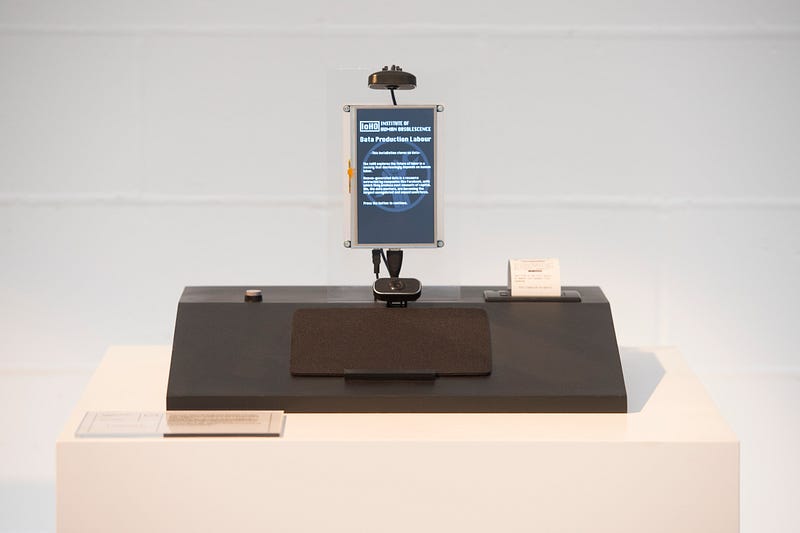
To exemplify this proposal, the author mentions the installation Data Production Labour (2017) by Manuel Beltrán, founder of Institute of Human Obsolescence, an art project that became known for proposing selling human warmth as a new form of paid labor through cryptocurrency mining. Simple and direct, the installation invites participants to place their smartphones on a stand and use their Facebook profile to scroll through their timeline for two minutes. While they interact with the device, two cameras monitor and analyze different parameters involving hand movements and facial expressions. Although simple, these gestures are transformed into valuable data for Facebook, holding great relevance especially for the advertising sector. “Therefore, the participant is working for Facebook. After working their shift, they receive a receipt that points out the units of attention, facial expression, and the speed at which they scrolled through the timeline during the process. It [the receipt] reveals that the participant worked for Facebook creating data and more capital—and, therefore, invites them to ask for payment,” explains Sophie.
What Beltrán’s installation points out, therefore, is the obscuring potential of the metaphor user:
“By saying that everyone can use their service for free, capitalist companies hide the datafication and exploitation of the technologically connected society. Just like the term platform, user is an important part of the discursive work of social media companies that claim to be open, egalitarian, and empowering to the individual (Gillespie, 2010). It is based on these various ideas that academics like Toffler (1980), Jenkins (2008), or Bruns (2008) point out that these new media consumption practices with the help of the internet allow for many-to-many communication, giving a voice to everyone and, therefore, constituting a new digital democracy. Social media monopolies are built on these confusing academic parameters by promising voice, freedom, and equality to users. As Fuchs (2012) argues, ‘the concept of exploitation is often not explained and clarified in these circumstances’ (p.143). To make the datafication and capitalization of the user visible and understandable, a counter-metaphor for the term user is urgently needed. The art installation Data Production Labour is capable of doing so by proposing a counter-metaphor that positions the individual as a worker. In this way, it creates a new understanding of capitalist power structures in a datafied reality. It is accessible, as well as interactive, and provides a narrative for the observer who is first navigating their Facebook timeline and then acquiring a receipt that reveals their activity counts as a work shift. Data Production Labour allows for collective action because it frames users as a new form of workers. Therefore, it [the installation] creates a collective identity that is not offered in debates surrounding user-generated content specifically or in general. It frames a ‘us’ versus ‘them’ from the Mouffeian (2005) point of view on antagonism and consequently allows us to ask new questions about the agency of social media monopolies in a datafied and capitalist society.”
Therefore, what Sophie proposes in her essay is the combination of art as an engine of activism capable of disrupting a system guided by “capitalist imperatives,” thus being able to reveal those power structures that permeate our reality, which often do not seem intelligible in the discourses currently presented by cyberactivism—that is, the lack of technical knowledge ends up being an obstacle to the important message of these groups reaching more people, which is essential when we are dealing with something as mass-marketed as the process of datafication.
In conclusion, Sophie writes that works like Beltrán’s “question social imaginaries and establish counter-metaphors” that expose the fallibility of technology and frame users as, in fact, workers. Such works are capable of empowering the individual by providing an “effective voice” and not just offering an opportunity for vocalization. “Art can awaken a dormant, technologically connected society by challenging and reshaping the dominant understanding of reality—therefore, it can make society act,” the author concludes.
